Free standard shipping on orders over $149.97
Instant hot water with no gas line, no vent pipe and no tank. Choose by kilowatts, flow rate and the electrical service your home can supply.
An electric tankless water heater heats water with copper or stainless elements as it flows through the unit. There is no burner, so you don't need a gas line, a flue or a condensate drain, and the unit can be mounted almost anywhere with water and power. Electric units are compact, quiet, nearly 100% efficient at the point of use, and have few moving parts to service.
The trade-off is power. Heating water fast takes a lot of electricity, so whole-house models need large breakers and heavy wire, and their flow drops in cold weather.
If you are shopping for a water heater electric and want to drop the tank, an electric water heater tankless model is the space-saving option. A tankless hot water heater electric unit, sometimes sold as an instant water heater electric or instantaneous electric water heater, only draws power while hot water flows.
| Type | Typical power | Voltage | Typical flow (warm / cold climate) | Best for |
|---|---|---|---|---|
| Point-of-use | 1.4–3.5 kW (up to 6 kW at 240V) | 120V or 240V | 0.3–1 GPM | One sink or a far bathroom |
| Mid-size | 9–18 kW | 240V | 1.4–2.7 GPM / 0.8–1.6 GPM | One shower, apartments, small homes |
| Whole house | 24–36 kW | 240V | 3.6–5.5 GPM / 2.2–3.3 GPM | 1–3 bathrooms, warm to mild climates |
Flow figures are approximate, calculated at a 45°F rise (warm climate) and a 75°F rise (cold climate). Actual flow depends on your incoming water temperature and the temperature you set.
For a whole house electric tankless hot water heater (also listed as a whole house on demand electric water heater), plan on 27–36 kW in warm climates. An outdoor electric tankless water heater or exterior electric tankless water heater is rare; most electric units are indoor-only.
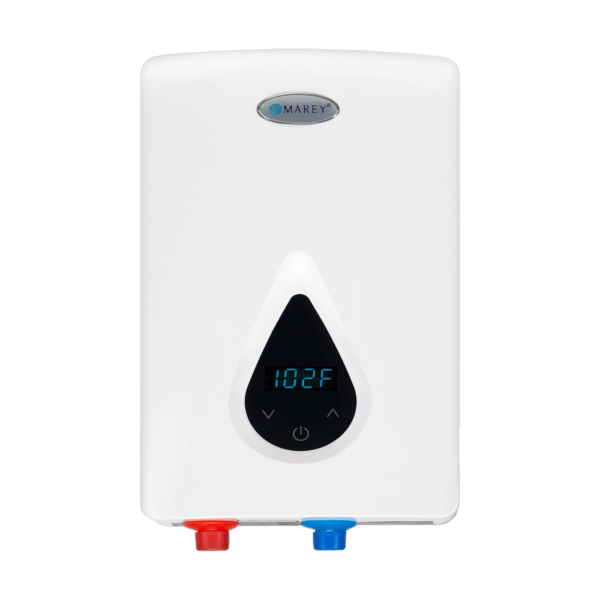
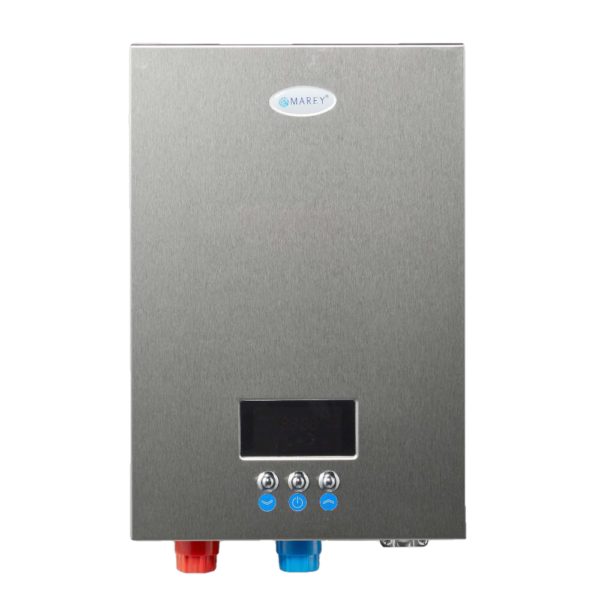
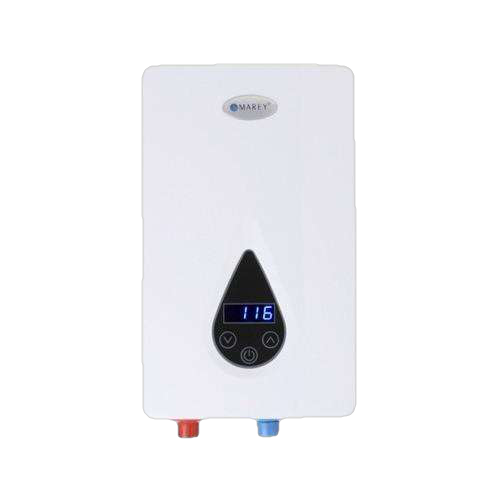
Brands currently listed in this category: Stiebel Eltron, Marey, Ariston and Chronomite. Each product page shows kW rating, flow, amperage, breaker and wire requirements.
Most electric tankless water heaters are rated for indoor installation in a space that stays above freezing. A few are designed for outdoor or exterior walls in mild climates. If you are looking for an outdoor unit, check the enclosure rating and freeze protection, or see our outdoor tankless water heaters.
If your home has natural gas or propane and you need high flow in a cold climate, a natural gas or propane tankless water heater will usually deliver more hot water per dollar of installation. For a single sink, a point-of-use water heater is simpler and cheaper.
Yes, in many homes. A 27–36 kW electric tankless water heater can deliver roughly 2.5–5.5 GPM depending on how cold your incoming water is. In warm southern climates that covers two showers at once; in cold northern climates it may cover only one shower in winter. Check with our sizing calculator.
It depends on the model. Small 120V point-of-use units may need a 15–30 amp circuit, while whole-house 240V units often need two to four 40–60 amp double-pole breakers and 100–150 amps in total. The installation manual lists exact breaker and wire sizes.
Whole-house electric units commonly need a 200-amp service or more, because they can draw over 100 amps by themselves. An electrician should do a load calculation before you buy.
It depends on local electricity and gas prices. Electric tankless units convert nearly all their energy into heat, but electricity usually costs more per unit of heat than natural gas. Compare in our gas vs electric guide.